Reading before bed can be a useful way to slow down at night, but the format matters. A quiet paper book is not the same sleep cue as reading on a bright phone while notifications, headlines, and group chats keep trying to drag your brain back into the day.
For most people, the safest sleep-friendly order is simple: paper book first, non-backlit or very dim e-reader second, phone last. The goal is not to make bedtime perfect. It is to make reading calm enough that it helps your wind-down routine instead of quietly extending your night.
Here is how to choose the right format and set up bedtime reading without turning it into another screen habit.
Does reading before bed help sleep?
Reading can help some people transition from daytime activity to rest. It gives your mind something steady to focus on, creates a repeatable cue, and can replace more stimulating habits like scrolling, late-night work, or watching short videos.
The benefit depends on the type of reading and the setting. A familiar novel under warm, low light is usually easier on sleep than a suspenseful work email, a news feed, or a bright screen held close to your face.
If bedtime reading makes you feel calmer and you still fall asleep at a reasonable time, it may be a useful part of your routine. If it turns into “just one more chapter” until 1 a.m., the issue may be boundaries rather than books.
Paper book vs e-reader vs phone: the quick answer
Paper book: usually the easiest sleep choice
A paper book avoids screen brightness, app notifications, and endless browsing. It also creates a clear separation from work and social media. For many people, that makes it the best default for bedtime reading.
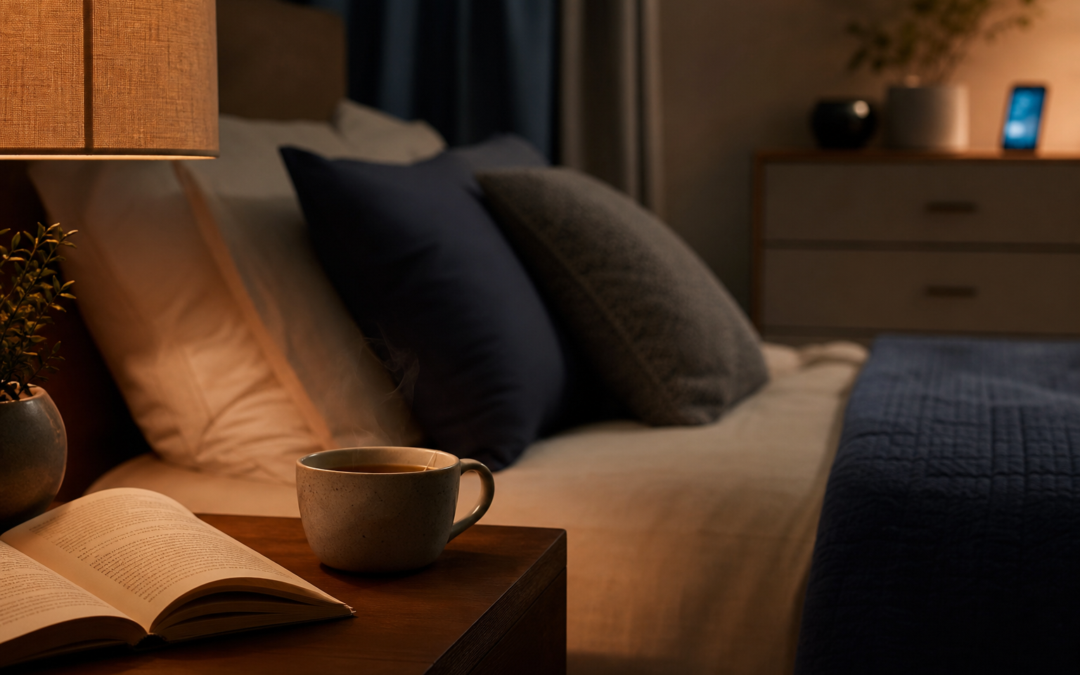
Use a small warm lamp instead of a bright overhead light. If you share the bedroom, a warm, focused reading light can reduce disruption without flooding the room.
E-reader: workable if the light is controlled
An e-reader can be a good option, especially if it is distraction-free and used with a dim, warm setting. The key is to avoid treating it like a tablet. If your device has apps, messages, videos, or web browsing, it can become a phone with better manners but the same bad instincts.
If you use an e-reader before bed, reduce brightness, choose warm light if available, use dark mode if it feels comfortable, and avoid shopping or browsing when you meant to read.
Phone: most likely to interfere
A phone is the hardest reading format to keep sleep-friendly. Even if the article or book is harmless, the device itself invites switching: one notification, one message, one quick search, one more video.
Phones also tend to be brighter, closer to the eyes, and more mentally stimulating. If you read on your phone, set a real boundary: bedtime mode, notifications off, brightness low, warm color setting on, and a hard stop time.
Why screens can be harder on bedtime
Light helps regulate your body clock. Bright evening light, especially from close-range screens, can signal alertness at a time when your body is supposed to be moving toward sleep. Research on light-emitting e-readers has found that evening use can affect sleep timing, circadian rhythm markers, and next-morning alertness compared with printed books.
That does not mean every screen instantly ruins sleep. It means screens are easier to overuse and may be more disruptive when they are bright, close to your face, emotionally engaging, or used late into the night.
The practical takeaway: if sleep is already fragile, make the last part of the evening darker, quieter, and less interactive.
How to make bedtime reading more sleep-friendly
Pick calmer material
Choose something enjoyable but not too activating. Fiction, essays, light nonfiction, poetry, or a familiar re-read often works better than work documents, stressful news, intense thrillers, or health searches that make you monitor every sensation in your body.
If a topic reliably raises your stress level, keep it out of the last 30 to 60 minutes before bed.
Set a reading window
A bedtime reading routine works best when it has edges. Try 10 to 30 minutes, then stop at a natural break. If you often read far later than planned, set a quiet alarm across the room or choose shorter chapters.
The point is to make reading a bridge to sleep, not the new reason you are underslept.
Keep the light warm and low
Use the least light that still lets you read comfortably. Warm, focused lighting is usually better than bright overhead lighting. If you notice eye strain, headaches, or squinting, do not force it. Adjust the setup or read earlier in the evening.
For more on light timing, see FSF’s guide to morning sunlight for sleep and blue light glasses vs screen dimming.
Put the phone out of reach
If you read a paper book or e-reader, charge your phone away from the bed. That one change removes the easiest detour into scrolling. If you use your phone as an alarm, place it far enough away that checking it is inconvenient.
This pairs well with a phone curfew. FSF’s guide to screens in bed and sleep walks through a practical version.
Use reading as part of a full wind-down routine
Reading works better when it is not carrying the whole routine by itself. Build a simple sequence: dim lights, finish hygiene, set tomorrow’s essentials, then read for a fixed window.
If you want a template, start with how to create a wind-down routine for better sleep.
What if reading makes you more awake?
Some people become more alert when they read, especially if the book is exciting or they are trying to finish a section. If that happens, shift reading earlier in the evening and use a lower-stimulation activity in bed.
Good alternatives include quiet breathing, gentle stretching outside the bed, relaxing audio at low volume, or a boring repeatable routine that does not involve a bright screen.
If you lie awake for a long time, try not to turn the bed into a place where you wrestle with wakefulness. Many sleep programs recommend getting out of bed briefly for a quiet, dim-light activity, then returning when sleepy. If insomnia is persistent, a clinician or CBT-I-trained professional can help you choose the right approach.
A simple bedtime reading setup to test this week
Try this for seven nights:
- Choose a paper book or distraction-free e-reader.
- Start reading 20 to 30 minutes before your target lights-out time.
- Use warm, low light.
- Keep your phone out of reach or in another room.
- Stop at the planned time, even if the chapter is not finished.
- Track whether you fall asleep more easily, wake less often, or feel better in the morning.
You are not looking for a perfect sleep score. You are testing whether reading makes your nights calmer and more consistent.
When bedtime sleep problems need more than a reading routine
A better reading setup can support healthy sleep habits, but it is not a cure-all. Consider talking with a qualified clinician if you have persistent insomnia, loud snoring, breathing pauses, gasping or choking at night, severe daytime sleepiness, pain that disrupts sleep, medication or supplement questions, or drowsy-driving concerns.
Those signs can have medical causes that deserve proper evaluation. A book can help you wind down; it cannot diagnose what is happening while you sleep.
Bottom line
Reading before bed can be a helpful sleep cue when it is calm, bounded, and low light. Paper books are usually the simplest option. E-readers can work if they are dim and distraction-free. Phones are the riskiest because they combine light, stimulation, and infinite detours in one tiny rectangle.
Start with the boring version: warm light, quiet book, phone away, fixed stop time. If your sleep improves, excellent. If not, you have still learned something useful about what your brain does at bedtime.
Sources
- Sleep Foundation: Reading Before Bed — https://www.sleepfoundation.org/sleep-hygiene/reading-before-bed
- Chang AM, Aeschbach D, Duffy JF, Czeisler CA. Evening use of light-emitting eReaders negatively affects sleep, circadian timing, and next-morning alertness. Proceedings of the National Academy of Sciences. 2015 — https://www.ncbi.nlm.nih.gov/pmc/articles/PMC4313820/
- CDC: About Sleep — https://www.cdc.gov/sleep/about/index.html
Disclosure and health note
Fast Sleep Fix may earn commissions from qualifying purchases if affiliate links are added to this article in the future. No affiliate links are currently included. This article is for general education only and is not medical advice. Sleep problems can have medical causes, especially when they involve loud snoring, breathing pauses, gasping, severe daytime sleepiness, pain, medication questions, or persistent insomnia. If symptoms continue or affect safety, talk with a qualified clinician.